pfun-cma-model
LLM Scenario Generation
Overview
The LLM scenario generation system translates natural language descriptions into physiologically valid CMA model parameters. It uses structured prompting with few-shot examples to ensure the generated parameters are biophysically sound.
sequenceDiagram
    participant User
    participant API as FastAPI Server
    participant LLM as LLM Backend
    participant CMA as CMA Model

    User->>API: POST /generate-scenario<br/>{"query": "..."}
    API->>LLM: Structured prompt with<br/>parameter table + example
    LLM-->>API: JSON response with<br/>parameters & recommendations
    API->>CMA: Validate parameters
    CMA-->>API: PFunLLMGeneratedScenario
    API-->>User: Validated scenario JSON
Live Demo
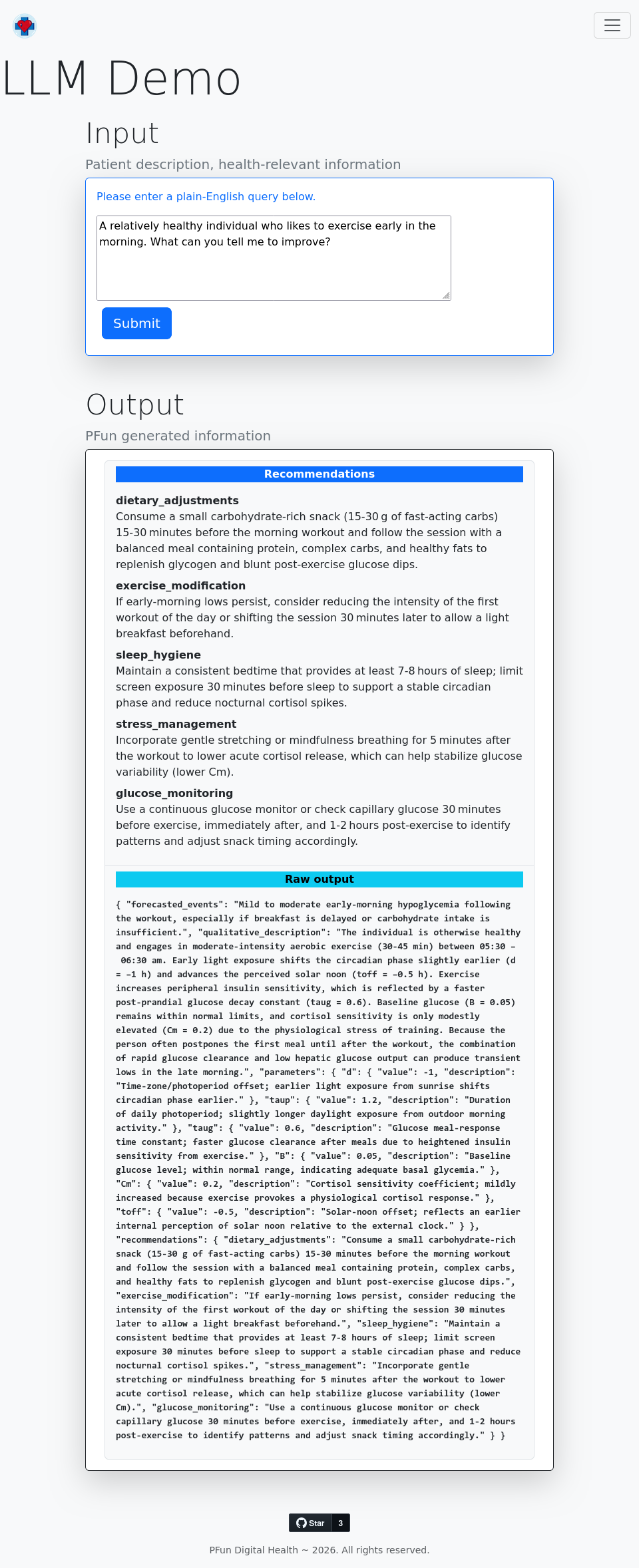
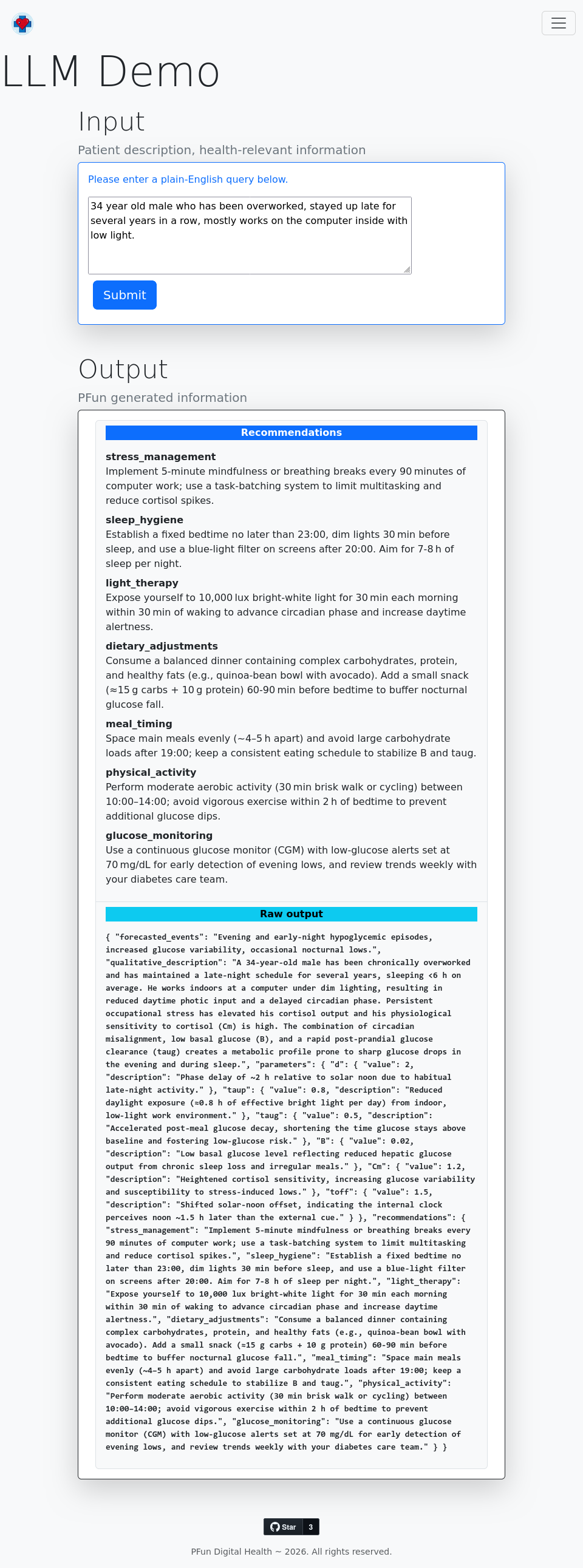
The demo at /demo/llm provides a text input where you describe a person’s health profile, and the system generates:
- Forecasted events — Predicted health outcomes
- Qualitative description — Clinical summary of metabolic health
- Parameters — CMA model parameters with values, descriptions, and standard errors
- Recommendations — Actionable health tips mapped to specific parameter deviations
Supported LLM Backends
| Backend | Config Value | Description |
|---|---|---|
| Ollama | ollama |
Local inference (default) |
| Google Gemini | google |
Cloud-based via google-genai |
| Perplexity | perplexity |
Online-search-augmented |
| OpenAI | openai |
GPT models |
Set via environment variable:
LLM_BACKEND=ollama # in .env
CLI Usage
# Generate a scenario
uv run pfun-cma-model generate-scenario \
  --query "a patient with chronic stress that exacerbates the risk of glucose lows in the evening"

# Default healthy individual
uv run pfun-cma-model generate-scenario
Python API
import asyncio
from pfun_cma_model.llm import generate_scenario

# Generate a scenario
scenario = asyncio.run(
    generate_scenario(
        query="an athlete who trains at 5am daily",
        include_recommendations=True,
    )
)

print(scenario.qualitative_description)
print(scenario.parameters)
print(scenario.recommendations)
Response Schema
The PFunLLMGeneratedScenario Pydantic model:
class PFunLLMGeneratedScenario(BaseModel):
    forecasted_events: str
    # Predicted health events

    qualitative_description: str
    # Clinical description of metabolic health

    parameters: dict[str, DescribedParameter]
    # {param_name: {value, description, stderr}}

    recommendations: dict[str, str]
    # {recommendation_type: specific_advice}
Each parameter includes:
class DescribedParameter(BaseModel):
    value: float | int       # Parameter value
    description: str         # Text description
    stderr: float            # Standard error estimate
How the Prompt Works
The LLM prompt includes:
- Baseline parameter table — Generated from
CMAModelParams().generate_markdown_table() - Few-shot example — A stressed individual with
Cm=1.5, B=0.001, taug=0.4 - Qualitative descriptors — Automatically generated labels (“Very High”, “Low”, etc.)
- Recommendation template — Maps parameter deviations to actionable advice
This ensures the LLM understands the parameter space and generates physiologically plausible values.